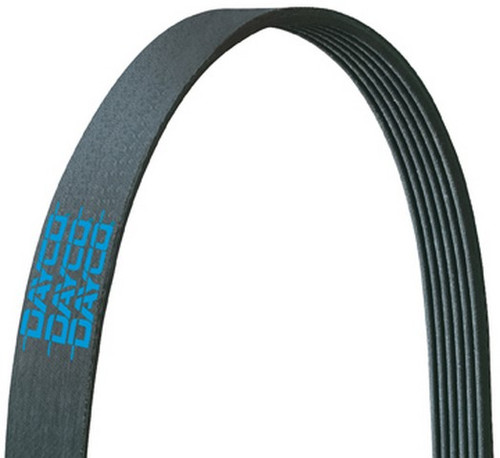
Dayco 5060468 serpentine belt for the 2019 Mazda CX-5 4-cylinder 2.2L and other vehicles drives the engine's belt-driven accessories. This Dayco drive belt is listed for main drive, alternator, water pump, air conditioning and tensioner positions.
- EPDM with aramid reinforcement
- K-section profile with straight ribs and standard rib depth
- Operating temperature range of -45 °F to 212 °F (-42.7 °C to 100 °C)
- Standards listed: SAE J1459 and SAE J2432
Quick facts
- Part: Dayco 5060468 serpentine belt
- Fits: 2019 Mazda CX-5 4-cylinder 2.2L and other vehicles
- Position: main drive, alternator and water pump, air conditioning, alternator and tensioner
- Material: EPDM, aramid reinforced
Cracked or frayed ribs, or a squeal from the belt area, can mean a worn belt. With the engine off and cool, look over the ribs and pulleys first, because a misaligned pulley or a weak tensioner can wear a belt out as well.
Fits
The vehicles it fits include the 1999-2001 Honda Odyssey and the 2009-2014 Acura TL V6 3.5L or 3.7L, along with many others. If your car is not named here, look it up in the "Vehicles it fits" section.
Specifications
Fit and size
- Position: main drive, alternator and water pump, air conditioning, alternator and tensioner
- Quantity per vehicle: 1
- Cross section: K-section
- Rib profile: straight rib
- Rib depth: standard
Build and materials
- Material: EPDM, aramid reinforced
- Standards: SAE J1459, SAE J2432
- Operating temperature: -45 °F to 212 °F (-42.7 °C to 100 °C)
In the box
One serpentine belt. This listing is one belt, and each vehicle takes one.
Interchange: 25-060468
6K468 · 6PK1190 · 6PK1185 · K060468 · 4060468 · 468K6
Product information is for general reference and may contain errors. See our Disclaimer.
This part cross-references / interchanges with the following part numbers:
6K468, 6PK1190, 6PK1185, K060468, 4060468, 468K6, 25-060468, 31110-RJA-J01, 04891704AA, 4891704AA, D1108-5691, D84-1000-3061190, LC3Z8620B, 12578002, 12621991, 31110-RJA-J02, 38920-P8F-306, 38920-P8F-A01, 38920-P8F-A02, 38920-P8F-A03, 38920-P8F-A04, SH0115909A, 1340A052
Frequently Asked Questions
Is this Dayco 5060468 a Honda Odyssey serpentine belt for the 1999-2001 model years?
Yes. Dayco 5060468 fits the 1999-2001 Honda Odyssey, and each one takes a single belt.
Is Dayco 5060468 a Mazda CX-5 serpentine belt replacement for the 2019 4-cylinder 2.2L?
Yes. Dayco 5060468 is listed for the 2019 Mazda CX-5 with the L4-2.2L engine, and that engine takes one belt.
What operating temperature range does this serpentine belt cover?
The operating range runs from -45 °F to 212 °F (-42.7 °C to 100 °C).
Is this serpentine belt made of EPDM?
Yes. It is EPDM with aramid reinforcement, in a K-section profile with straight ribs.
What wear signs should I look for on a K-section serpentine belt like this one?
Look for cracks, fraying or glazing on the ribs, by eye with the engine off and cool. If you are unsure, a shop can inspect the belt.