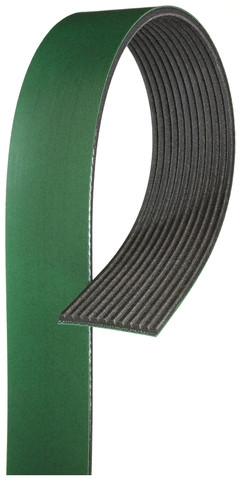
Gates K040353 serpentine belt for the 1998-2007 Subaru Forester H4 2.5L and other vehicles drives the alternator, power steering and air conditioning from the engine. It is one of the Gates serpentine belts made as a Micro-V belt.
- Gates Micro-V construction with 4 ribs, made for a precision fit
- Special belt construction eliminates belt noise and reduces tension loss
- EPDM rubber resists cracking on the rib surface
- Polyester cord material in a K cross section belt
Quick facts
- Part: Gates K040353 serpentine belt
- Fits: the 1998-2007 Subaru Forester H4 2.5L and other vehicles
- Position: Alternator, power steering, air conditioning
- Material: EPDM
- Condition: New
Cracked or frayed ribs, or a squeal from the engine, can mean the belt is worn. Before you replace it, rule out a seized pulley or a weak tensioner, since either one can wear out a new belt as well. Tensioner replacement is recommended if the engine has one.
Fits
The 1998-2007 Subaru Forester H4 2.5L, the 2000-2007 Subaru Outback H4 2.5L and the 1999-2001 Honda CR-V 4-cylinder 2.0L are among the vehicles this belt fits. Gates builds it to the OE size, construction and materials.
Specifications
Fit and size
- Position: alternator, power steering, air conditioning
- Quantity per vehicle: 1
- Cross section: K
- Rib count: 4
- Top width: 14 mm (0.56 in, 9/16 in)
- Outside circumference: 912 mm (35.875 in)
- Effective length: 897 mm (35.33 in)
Build and materials
- Type: automotive V-ribbed belt (standard)
- Material: EPDM
- Cord material: polyester
- Grade: OE Performance
- Condition: New
- Country of origin: Mexico
In the box
One serpentine belt. This listing holds one belt, and each vehicle takes one.
Product information is for general reference and may contain errors. See our Disclaimer.
Frequently Asked Questions
Is this the serpentine belt for the 1999-2001 Honda CR-V 4-cylinder 2.0L?
Yes. Gates K040353 is listed for the 1999-2001 Honda CR-V 4-cylinder 2.0L and many other vehicles. If your car is a different one, look it up in the "Vehicles it fits" section.
Are Gates ribbed belts like this one made of EPDM?
Yes. The Gates K040353 is EPDM rubber with a polyester cord and 4 ribs, and the EPDM resists cracking on the rib surface.
What are the specs of Gates drive belts like this K040353?
It has a K cross section, 4 ribs, a 14 mm top width, an effective length of 897 mm and an outside circumference of 912 mm.
Is this Gates Micro-V serpentine belt an OE Performance grade?
Yes. This belt is OE Performance grade and is made to the OE size, construction and materials.
Should the tensioner be replaced along with a new serpentine belt?
Tensioner replacement is recommended when the engine has one. The belt and tensioner work together on the accessory drive.