

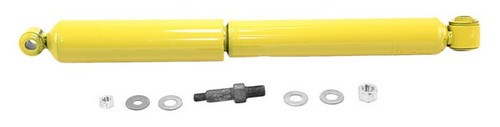

Get firm, controlled truck-and-van handling without a harsh ride from the Monroe Gas-Magnum Suspension Shock Absorber 34912. This front shock installs as a direct-fit replacement for the 1986-1999 Chevrolet P30, 1987-1989 Chevrolet S7, 1980-1989 GMC C5000, C6000 and C7000, and the 1986-1999 GMC P3500 — see the Buyer's Guide tab for engine-level details.
- Designed for trucks and vans: engineered for hardworking full-size trucks and vans, with full-displaced valving on compression cycles for controlled ride and handling.
- Built to last: a heavy-duty nitrocarburized rod (non-dust-shield units only) and sintered iron piston add durability, while a self-lubricating fluid seal reduces friction against the piston rod to cut wear.
- Consistent ride: OE all-weather fluid with special modifiers handles extreme temperatures and helps smooth rod reaction.
- Nitrogen gas-charge: maintains tire-to-road contact by reducing aeration and shock fade for improved ride and handling.
- Longer service life: a larger bore and bigger 2-in. reserve tube hold more oil — up to twice the fluid capacity of standard 1-in. bore shocks — so the shock works efficiently.
Backed by Monroe's Limited Lifetime Warranty and exclusive Feel the Difference™ Guarantee.
Interchange: 560567 · 22002294 · 58403 · 58625 · 727631 · 9160499 · 345030 · KG6001A · 76912 · NS66637 · 12130188 · 12140418 · 3919919
This part cross-references / interchanges with the following part numbers:
Frequently Asked Questions
What vehicles does the Monroe 34912 shock fit?
It's a front shock for the 1986-1999 Chevrolet P30, 1987-1989 Chevrolet S7, 1980-1989 GMC C5000, C6000 and C7000, and 1986-1999 GMC P3500. Check the Buyer's Guide tab for engine-level details.
Is this a front or rear shock?
The catalog lists the 34912 as a front suspension shock absorber for the applications shown.
What makes the Gas-Magnum different from a standard shock?
It uses a larger bore and a bigger 2-in. reserve tube that hold more oil — up to twice the fluid capacity of standard 1-in. bore shocks — along with full-displaced compression valving.
What are signs my shock may need replacing?
Common signs include excessive bouncing, poor ride control, uneven tire wear, or fluid leaking from the shock. Have the suspension inspected to confirm the cause before replacing.
Should I replace shocks in pairs?
Replacing both shocks on the same axle together is recommended for balanced, even ride control, though this listing is for one shock.
Write a Review