


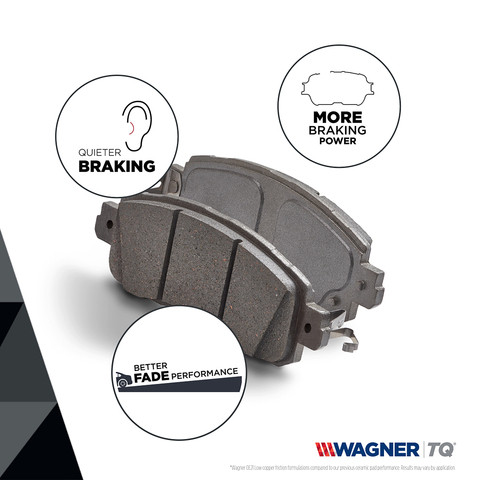

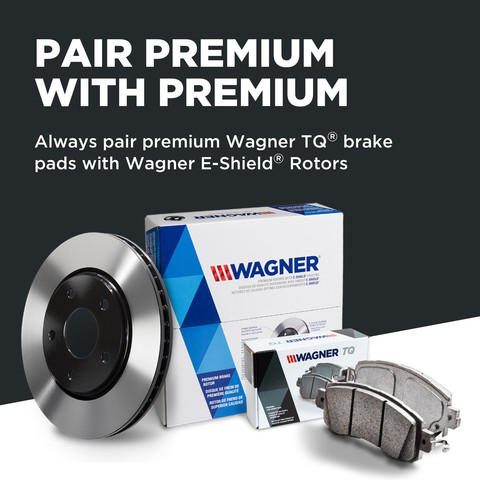


Quiet, low-dust braking for your daily drive — the Wagner ThermoQuiet QC1413 Front Ceramic Disc Brake Pad Set drops in as a direct-fit replacement for the 2010-2016 Hyundai Genesis Coupe [All] and the 2011-2015 Kia Optima [All], covering the front axle.
Built around Wagner's zero-copper OE25™ ceramic friction formulation with a unique Integrally Molded Insulator (IMI™) design, this set is made for quieter, cleaner everyday stops.
- Quieter operation: application-specific, laser-shaped friction plus IMI™ insulator technology spreads out heat, sound, and vibration to reduce noise opportunities.
- Cleaner wheels: the ceramic, zero-copper formulation gives off less visible dust than conventional semi-metallic pads during everyday street driving.
- Consistent friction: the formulation is designed to help manage heat for long-lasting friction performance and reduced fade in normal driving.
- Ready to install: slotted, chamfered pads with pad shims, abutment clips, and a mechanical pad wear sensor included; premium stainless-steel hardware is included on select applications.
For even, balanced braking, replace the pads on both front wheels together as a matched set. Country of origin: United States.
Manufacturer part number QC1413 · FMSI 8527-D1413.
This part cross-references / interchanges with the following part numbers:
Frequently Asked Questions
Will this pad set fit my vehicle?
It's cataloged for the 2010-2016 Hyundai Genesis Coupe [All] and the 2011-2015 Kia Optima [All], front axle. Check the Buyer's Guide tab to confirm your exact vehicle.
Which axle does this set cover?
This is a front disc brake pad set. One set covers the front axle (both front wheels); replace both sides together as a matched set for balanced braking.
What's included in the set?
The set includes pad shims, abutment clips, and a mechanical pad wear sensor. Premium stainless-steel hardware is included on select applications.
Are these ceramic pads, and what's the benefit?
Yes — ceramic friction with Wagner's zero-copper OE25™ formulation, giving lower dust and quieter operation than conventional semi-metallic pads during everyday street driving.
What type of wear sensor do they use?
They include a mechanical pad wear sensor, which signals contact as the pads approach their wear limit.
Write a Review