


Wagner Brake Disc Brake Pad Set P/N:ZD2177
Wagner Brake SX2281 rear brake pad for the 2020-2025 Ford Transit-350 HD is a SevereDuty pad designed for hard, frequent braking. This Wagner Brake disc brake pad set is a direct-fit replacement for that vehicle.
A squeal or grinding when braking, longer stopping distances or vibration under braking can mean the rear pads are worn. Those signs alone don't prove the pads are at fault, since a sticking caliper can produce similar symptoms. Rear pads are normally replaced on both sides of the axle together, and this listing is one set.
The 2020-2025 Ford Transit-350 HD takes one set, on the rear axle.
Fit and size
Build and materials
Interchange / FMSI:
FMSI: 9519-D2281 · D2281
Interchange: 1214-2281-00 · 1214-2281-01 · 1551-2281-00 · 1551-2281-01 · 4000-2281-00 · 4000-2281-01 · MKD2281 · SM2281 · FLD2281 · GMKD2281 · PMD2281H · DG2281 · LK4Z2200F
This part cross-references / interchanges with the following part numbers:
Does the Wagner Brake SX2281 fit the 2020-2025 Ford Transit-350 HD?
Yes. Wagner Brake SX2281 is listed for the 2020-2025 Ford Transit-350 HD. It is a rear pad, so it goes on the rear axle and not the front.
Are these Wagner SevereDuty pads semi-metallic or ceramic?
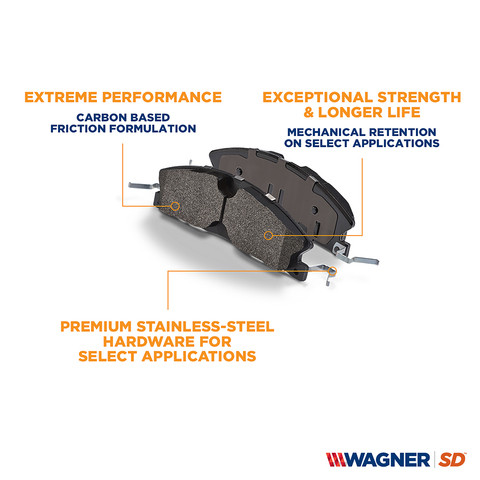
They are semi-metallic. The friction material is carbon-based and was engineered in-house for long-lasting braking performance.
Do the Wagner SX2281 pads contain copper?
No. Wagner Brake SX2281 uses the Wagner OE25 zero-copper friction formulation.
Can I keep driving if my rear brake pads are worn out?
No. Worn rear pads should be inspected and replaced promptly rather than driven on, and a shop can confirm what is causing the symptoms.
Do these SevereDuty rear pads have shims, slots and chamfers?
Yes. They have OE-style shims, slots and chamfers, and they went through OE-style on-vehicle testing for extreme heat, frequent stopping and heavy loads.
No reviews yet — be the first to review this product.
Write a Review
WARNING: These products can expose you to chemicals including lead and phthalates, which are known to the State of California to cause cancer and birth defects or other reproductive harm. For more information go to www.P65Warnings.ca.gov.