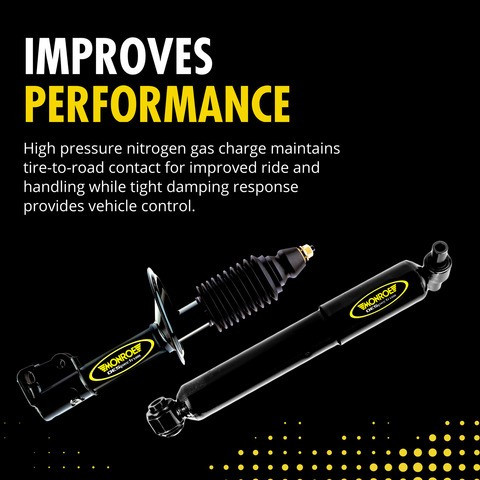
Help keep the rear of your vehicle settled and composed with the Monroe shock absorber 210167 from the Monroe Restore line. This rear unit is a direct-fit replacement for the 1991-2003 Ford Explorer, 1991-1994 Mazda Navajo, 1997-2000 Mercury Mountaineer, 2001-2003 Ford Explorer Sport, and 2001-2005 Ford Explorer Sport Trac.
Monroe designed its Restore shock absorbers to deliver consistent performance. They provide a high level of handling and control while filtering out noise, vibration and harshness.
- Nitrogen gas charge: helps maintain tire-to-road contact for improved ride and handling by reducing aeration and shock fade.
- Banded piston: helps reduce friction between the piston and pressure tube, improving responsiveness to changing road surfaces for smooth operation.
- Validated performance: designed and validated by Monroe for consistent performance.
- Broad coverage: the Restore line is offered for domestic and import passenger cars, light trucks and SUVs.
As a suspension shock absorber, it dampens the up-and-down motion of the springs to help keep the tires planted. Signs a rear shock may need replacing include excessive bouncing after bumps, rear-end sway, fluid leaking from the body, and uneven tire wear. Replacing rear shocks in pairs is recommended for balanced handling. See the Buyer's Guide tab for engine details and the full application list.