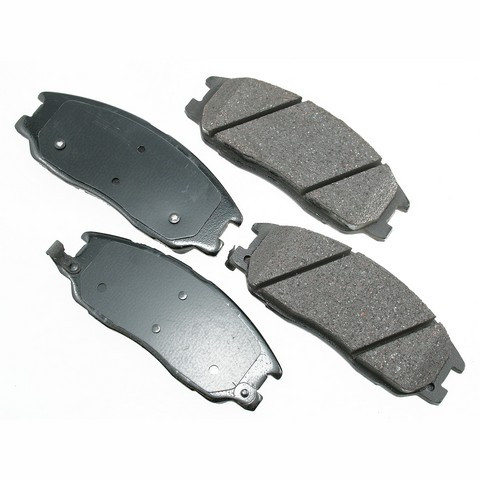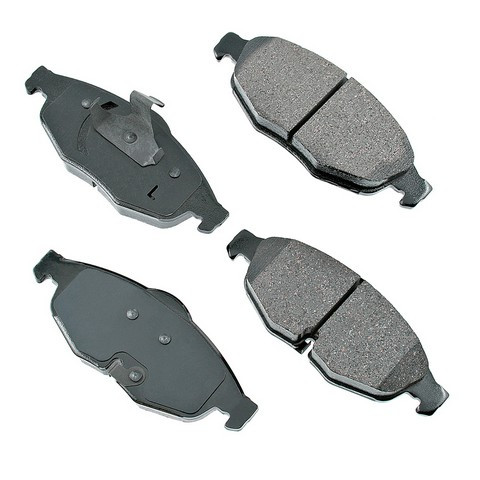
Akebono ProACT Disc Brake Pad Set P/N:ACT869
Help keep noise, vibration and harshness in check at the rear wheels with the Akebono ProACT Ultra-Premium Ceramic Brake Pad, part number ACT537A, a rear disc brake pad set built around an application-specific ceramic formulation. It fits many vehicles, among them the 2002-2015 Honda Civic, 1990-2007 Honda Accord and 2011-2015 Honda CR-Z. See the Buyer's Guide tab for the full list of applications.
If you are shopping for 2013 Honda Civic brake pads for the rear axle, this ProACT set uses an OE-validated, application-specific ceramic formulation. Its precision-cut pressure plates and engineered chamfers and slots are designed for braking performance and NVH control.
Rear pads wear with use. Squealing or grinding from the rear brakes, longer stopping distances or thin friction material are signs the pads may need replacing. Diagnose the cause first, and inspect the rotors at the same time.
This part cross-references / interchanges with the following part numbers:
Is this the right 2002-2015 Honda Civic brake pad for the rear?
ACT537A is cataloged as a rear pad set for listed 2002-2015 Honda Civic applications. The Buyer's Guide tab shows which versions it fits.
Does it also fit the 1990-2007 Honda Accord and 2011-2015 Honda CR-Z?
The listed applications include the 1990-2007 Honda Accord and the 2011-2015 Honda CR-Z. Many other vehicles are shown in the Buyer's Guide tab.
What friction material do these pads use?
They use an OE-validated, application-specific ceramic formulation from Akebono's ProACT Ultra-Premium line.
What are the chamfers and slots for?
Akebono engineers the chamfers and slots, along with the precision-cut pressure plates, for braking performance and control of noise, vibration and harshness (NVH).
What are signs my rear brake pads may need replacing?
Squealing or grinding, longer stopping distances or visibly thin friction material can mean the pads may need replacing. Inspect the rotors when you change pads.
WARNING: These products can expose you to chemicals including lead and phthalates, which are known to the State of California to cause cancer and birth defects or other reproductive harm. For more information go to www.P65Warnings.ca.gov.