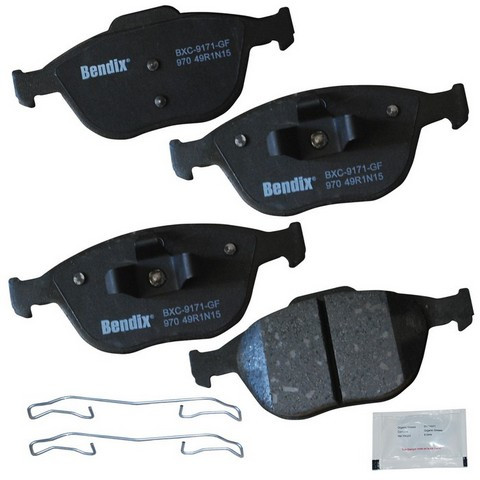
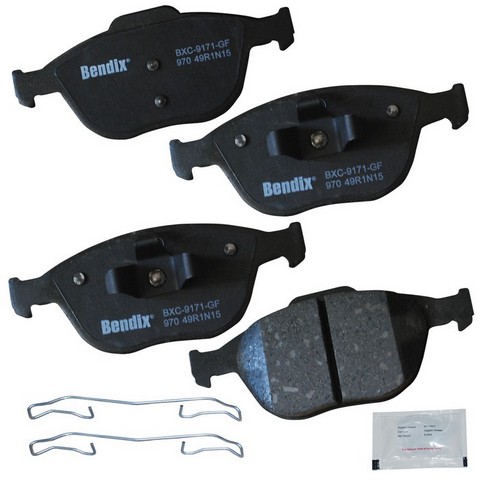
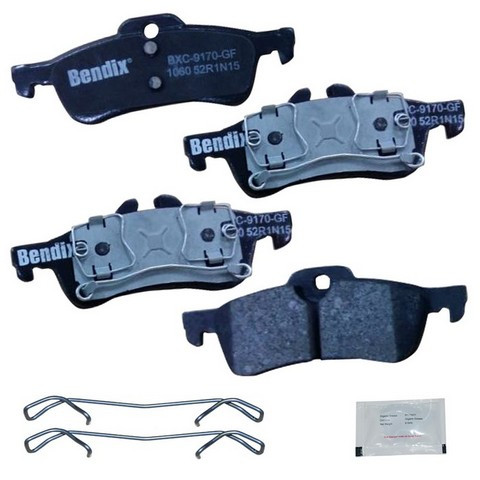
Help keep braking smooth and confident at the front axle with the Bendix Disc Brake Pad Set (CFC970). These front brake pads drop in as a direct-fit replacement for the 2002-2004 Ford Focus and the 2010-2013 Ford Transit Connect, giving your car the friction material it needs to slow and stop through everyday driving.
Copper-free friction: part of the Bendix Premium Copper Free offering, a line of pads and shoes committed to the Copper-Free Initiative in North America.
Front-axle set: cataloged for the front position, this set supplies the pads for your front disc brakes.
Direct-fit replacement: built to serve as the replacement friction for the listed Ford applications.
See the Buyer's Guide tab to confirm the exact engine and configuration for your vehicle. Worn pads often show up as squealing or grinding, longer stopping distances, or a thin friction layer — if worn front pads are the cause, this set replaces them. For even, balanced braking, replace the pads on both front wheels together as a matched set.
Frequently Asked Questions
Does this brake pad set fit the 2002-2004 Ford Focus?
Yes. It's cataloged as a direct-fit front set for the 2002-2004 Ford Focus. Check the Buyer's Guide tab to confirm your exact vehicle.
Are these Bendix pads copper-free?
Yes. They're part of the Bendix Premium Copper Free offering, a line of brake pads and shoes committed to the Copper-Free Initiative in North America.
Which axle does CFC970 cover?
This set is cataloged for the front position, so it supplies the pads for your front disc brakes.
What are signs my front brake pads may need replacing?
Common signs include squealing or grinding noise, longer stopping distances, or a thin friction layer. Have the brakes inspected to confirm the cause before replacing.
Should I replace both sides at once?
For even, balanced braking it's best practice to replace the pads on both front wheels together as a matched set rather than one side alone.
WARNING:
These products can expose you to chemicals including lead and phthalates, which are known to the State of California to cause cancer and birth defects or other reproductive harm. For more information go to
www.P65Warnings.ca.gov.