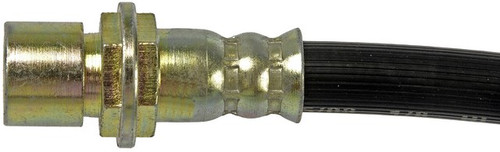
Keep brake fluid moving to the front left brake with this Dorman brake hydraulic hose, First Stop part number H620911, a flexible link between the vehicle's rigid brake line and the brake at the wheel. It fits many vehicles, among them the 2006-2011 Dodge Charger, 2005-2011 Chrysler 300 and 2009-2010 Dodge Challenger. It is a direct-fit replacement for the listed applications. See the "Vehicles it fits" section for the full list and engine details.
- Engineered like the original: precision-engineered to perform like the original brake hose on specific vehicles and positions, as part of a complete brake repair.
- Position-specific: built to precise measurements for the front left position, for an exact fit and easy installation.
- Quality assured: materials tested to exacting government-regulated safety and durability standards.
- Durable design: EPDM rubber hose with specially coated, corrosion-resistant fittings.
A brake hose carries pressurized fluid while flexing with every suspension and steering movement. Over time the rubber can crack, swell or seep. Cracks or bulges in the hose, fluid at the fittings, or a soft, spongy pedal are signs this part may need replacing. Diagnose the cause before you replace parts.
This hose is sold individually for the front left position. Replacing the hoses on both sides together is recommended. After installation, bleed the brake system. Consult the vehicle service information for torque values, any sealing washers or fasteners, and whether they may be reused.
Interchange: 150.63076 · 150.63088 · 350-40042
15063076 · 15063088 · 35040042 · 611657 · 5140864AA · 68071591AA · BH382373 · 2204382 · BH144274 · F144274
This part cross-references / interchanges with the following part numbers:
611657, 150.63076, 150.63088, 5140864AA, 68071591AA, 350-40042, BH382373, 2204382, BH144274, F144274
Frequently Asked Questions
What does this brake hydraulic hose do?
It carries pressurized brake fluid from the vehicle's rigid brake line to the front left brake. It flexes as the suspension and steering move.
Which vehicles does the Dorman H620911 brake hose fit?
It fits many vehicles, including the 2006-2011 Dodge Charger, 2005-2011 Chrysler 300 and 2009-2010 Dodge Challenger. Check the "Vehicles it fits" section for your exact vehicle.
What is this brake hose made of?
The hose is made with EPDM rubber, and its fittings are specially coated for corrosion resistance.
What are signs a brake hose may need replacing?
Signs include cracked, swollen or bulging rubber, fluid seeping at the hose or fittings, or a soft, spongy pedal. Inspect the brake system to confirm the cause before replacing parts.
Do I need to bleed the brakes after installing it?
Yes. Opening the hydraulic system lets air in, so bleed the brakes after installation. Follow the vehicle service information for the procedure, torque values and any sealing washers.