
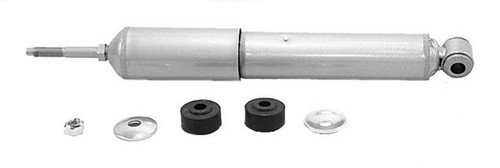
Smooth out the ride and keep the rear tires planted on your classic Ford truck with the Monroe OESpectrum Rear Suspension Shock Absorber 37037. This nitrogen gas-charged light-truck shock is designed to restore original factory drivability and control while filtering out impact-related noise, vibration, and harshness. It's a rear-position direct-fit replacement for the 1980-1996 Ford Bronco, 1980-1983 Ford F-100, and 1980-1984 Ford F-150 — see the Buyer's Guide tab for engine-level details.
- Exceptional handling: Full displaced valving, tuned to the vehicle, adjusts to road extremes, while the larger bore provides more efficient damping control for a consistent, smooth ride.
- Control and durability: A PTFE-banded piston maintains consistent sealing between the piston and pressure tube for better control and increased durability.
- Reduced NVH: The Twin Technology Active Control System delivers control under most driving conditions while isolating impact-related noise, vibration, and harshness.
- Nitrogen gas-charge: Helps maintain tire-to-road contact by reducing aeration and shock fade for improved ride and handling.
OE all-weather fluid with special additives helps handle temperature extremes and reduce oil breakdown, and a self-lubricating fluid seal retains gas while reducing friction against the piston rod. Backed by Monroe's Limited Lifetime Warranty and Feel the Difference Guarantee.
Interchange: TS3332542B · 342501 · 342512 · E7TZ18125N · G63409 · 344077 · 344078 · 210169 · SH81710 · 12140240
This part cross-references / interchanges with the following part numbers:
Frequently Asked Questions
What position does this shock absorber install in?
The Monroe OESpectrum 37037 is a rear suspension shock absorber for the listed applications.
Which vehicles does the 37037 fit?
It's a direct-fit rear replacement for the 1980-1996 Ford Bronco, 1980-1983 Ford F-100, and 1980-1984 Ford F-150. Check the Buyer's Guide tab to confirm your vehicle.
Is this shock gas-charged?
Yes. It uses a nitrogen gas-charge that helps maintain tire-to-road contact by reducing aeration and shock fade for improved ride and handling.
What are signs my rear shocks may need replacing?
Common signs include excessive bouncing over bumps, a rougher or less controlled ride, nose dive, or uneven tire wear. Diagnose the cause before replacing.
Should I replace shocks in pairs?
Replacing shocks as a pair on the same axle is recommended for balanced, consistent ride control. This listing is for the rear position; confirm the quantity your vehicle needs.
Write a Review