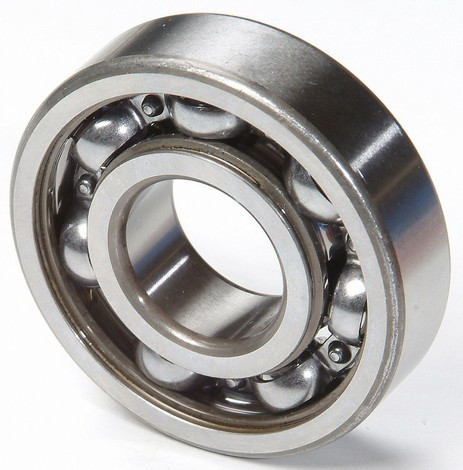
Keep your alternator or generator spinning smoothly with the Schaeffler 6203-RSR bearing, a ball bearing that supports the rotating shaft inside the charging unit. It is a direct-fit replacement for many vehicles, among them the 1984-1985 Honda Civic 1.3L / 1.5L, 1984 Honda Accord 1.8L and 1983-1990 Jeep Cherokee 2.1L / 2.5L / 2.8L / 4.0L / 4.2L / 5.9L. See the Buyer's Guide tab for the full list of applications.
Schaeffler describes this part as a radial insert ball bearing. It is cataloged as a generator drive end bearing, generator commutator end bearing and alternator bearing, and is listed for front, rear and drive-end positions depending on the application.
- OE expertise: Schaeffler is an OE manufacturer, and it designs and builds its bearings to stringent OEM standards.
- Smooth operation: Engineered to help reduce friction and wear as the shaft turns.
- Durability: Made with high-grade materials for dependable reliability.
- Country of origin: Japan.
Signs an alternator bearing may need replacing include a whining, growling or grinding noise from the alternator that changes with engine speed, or roughness or play when the pulley is turned by hand. Diagnose the source before replacing parts, because a worn belt, tensioner or idler pulley can make similar noises. Each listed application uses a quantity of one, and this listing is for one bearing.
Interchange: 6203-RS · 6203-RS1 · 6203-RSH · 6203-RSJ
6203RS · 6203RS1 · 6203RSH · 6203RSJ · 6203LU · 6203E
This part cross-references / interchanges with the following part numbers:
6203LU, 6203-RS, 6203-RS1, 6203-RSH, 6203-RSJ, 6203E, 6203RSR