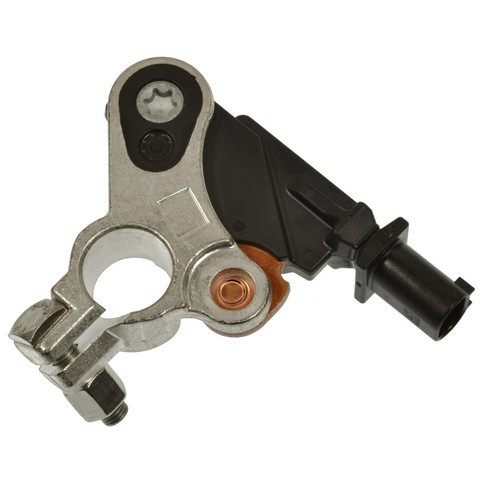
Standard Ignition BSC7 sensor for the 2015-2020 Ford F-150 V6 2.7L and other vehicles reads battery current and voltage for the vehicle's Battery Management System (BMS).
- Components that accurately measure the battery's charge and discharge
- Detects low or insufficient electrical voltage together with the BMS
- Input that lets the vehicle computer adjust charging voltage, idle speed and other parameters to help fuel efficiency and battery life
- 100% tested for performance and reliability
Quick facts
- Part: Standard Ignition BSC7 sensor
- Fits: the 2015-2020 Ford F-150 V6 2.7L and other vehicles
- Condition: New
A battery or charging warning light, a battery that keeps running down, or Start/Stop behavior that changes can mean the sensor is failing. Before you replace it, rule out a weak battery, loose or corroded cable ends and a charging system fault, because any of them can light the same warnings.
Fits
It is a direct-fit OE replacement for the 2015-2020 Ford F-150 V6 2.7L, the 2013 Ford Fusion 4-cylinder 1.6L or 2.5L, the 2013-2018 Fusion 4-cylinder 2.0L, the 2014-2018 Fusion 4-cylinder 1.5L, the 2013-2016 Lincoln MKZ V6 3.7L and the 2013-2018 MKZ 4-cylinder 2.0L. Each car needs one sensor.
Specifications
Fit and size
- Quantity per vehicle: 1
- Connector shape: Oval
- Connector type: Plug In
- Connector gender: Female
- Connector quantity: 1
- Terminal type: Pin
- Terminal gender: Male
- Terminal quantity: 2
Build and materials
- Condition: New
- Country of origin: Hungary
Interchange: CTB9 · BCSA14 · SBC8 · DS7Z10C679A
This part cross-references / interchanges with the following part numbers:
CTB9, BCSA14, SBC8, DS7Z10C679A
Frequently Asked Questions
Does this sensor fit the 2013 Ford Fusion 4-cylinder 1.6L or 2.5L, the 2013-2018 Fusion 4-cylinder 2.0L and the 2014-2018 Fusion 4-cylinder 1.5L?
Yes. Standard Ignition BSC7 is listed for each of those Fusion years and engines, and each needs one sensor.
Is this one of the sensors for the 2015-2020 Ford F-150 V6 2.7L?
Yes. The BSC7 is listed for the 2015-2020 Ford F-150 with the V6 2.7L engine, and the truck needs one.
What connector does the Standard Ignition BSC7 battery current sensor use?
The BSC7 has one oval, female plug-in connector with two male pin terminals.
Is each BSC7 sensor tested?
Yes. Standard Ignition runs 100% testing on every unit to confirm performance and reliability.
Is DS7Z10C679A an interchange number for the Standard Ignition BSC7?
Yes. DS7Z10C679A is listed for this sensor, along with CTB9, BCSA14 and SBC8.